


Digital Town Tour
In this digital town tour, we would like to introduce you to the sights of Weißenstadt, their history and what makes them special. The audio guides are in Germa…
Overview of the stops
- Landmarked Historical Center
- St James’ Protestant Town Church
- The Bummelhenker
- Historic Rows of Barns
- Historic Spa Park
- Holy Trinity Cemetery Church
- Rock Cellars
- Weißenstadt Lake
- The Story of the Bergkristall
- Ehrenhain Memorial Grove and War Memorial
- Catholic Church of St Mary Immaculate
You are currently viewing a placeholder content from OpenStreetMap. To access the actual content, click the button below. Please note that doing so will share data with third-party providers.
More Information
Landmarked Historical Center
Modern Weißenstadt - historic Weißenstadt. The historical center of town is listed in its entirety because of its cultural and historic relevance to the city.


St James’ Protestant Town Church
St James’ Protestant Town Church is very old. It stands in a central location on Weißenstadt’s market square.
Show transcript
St James’ Town Church is very old. It was originally a church dedicated to the Virgin Mary. It is thought to have been built by Cistercians as a Romanesque basilica. Structural alterations were only made later, in the early 16th century. It was largely destroyed in the great town fire of 1823. Only the walls remained standing. On Reformation Day 1827 the church was reconsecrated. Since then, the spacious interior has been defined by the double galleries along the sides, elegantly rounded at the front. The pulpit altar was made of wood in the late Neoclassical style between 1827 and 1830 by the Wunsiedel joiner Johann Adam Opel. Today a section of the Way of St James begins here, passing the cemetery church, which was spared by the fire and whose Baroque furnishings have survived. The town church is a stately vaulted building with a late Gothic appearance and a refined late Neoclassical interior. Known as St Mary’s Church in pre-Reformation times, the church was named St James’ Church after its enlargement at the beginning of the 16th century. Only the chancel and the 39-metre tower of rubble masonry date back to the late Gothic period, around 1518. The lower sections of the nave walls date back to the Romanesque period. Its Gothic-style buttresses were rebuilt in 1716. Soon afterwards the walls were raised and closed with a Baroque vault. A particular highlight in terms of art history is the crystal cross standing on the altar, created in the 1950s by Professor Dr Hermann Jünger of Munich and decorated with 24 rock crystals from Weißenstadt. The portrait of Luther by the famous artist Christoph Wetzel shapes the Protestant church interior. There is also a Neo-Baroque organ with music-making angels and the Hohenzollern coat of arms, built in 1891 by the renowned organ builder G. F. Steinmeyer of Oettingen. Also worth seeing are the Neo-Gothic font from 1860 (donated by Erhard Ackermann), the large wooden crucifix from the 16th century and figures of the risen Christ and of the church’s patron saint, St James.

The Bummelhenker
The people of Weißenstadt are known as the Bummelhenker. The name goes back to a famous legend of the Fichtel Mountains.
Show transcript
The people of Weißenstadt are known as the Bummelhenker. The story behind the name goes like this: the church tower of Weißenstadt had several ledges. On the lowest one, which was particularly wide, grass grew in summer. The same was true of the town wall that encircled the town. The mayor, being a thrifty man, did not want the grass to wither away unused. After various other suggestions had been rejected, it was agreed to let the small community bull graze on it. So a rope was let down from the wall and the animal was hauled up with it. When, throttled by the rope, it stuck out its tongue, everyone thought it could already taste the grass. But they could not get the bull’s head over the ledge, and in the end they let the animal back down. When they took a closer look, it was dead. The townspeople were glad that they had not hauled up the big community bull. And that is how the people of Weißenstadt came by their nickname, the Bummelhenker. (Extract from the Weißenstädter Heimatbuch, the local history book by Georg Kraus)

Historic Rows of Barns
The Historic Rows of Barns in Weißenstadt are unique in urban planning.

Historic Spa Park
The Historic Spa Park is a very special project, created on the site of a former stone-processing works.
Show transcript
The historic spa park is a very special art project created on the site of a former stone-processing works. Weißenstadt’s historic spa park was laid out in 1994 on the western shore of the Weißenstädter See. Flower and plant beds with a natural feel have been integrated between the ruins of the former stone-polishing works. Erhard Ackermann (born 8 August 1813, died 9 January 1880) is the town’s most famous son. Thanks to his inventiveness, he developed a special technique for polishing hard granite and was regarded as the inventor of the art of industrial hard-stone polishing. In 1867 he built a gigantic granite-polishing works in Weißenstadt, on the banks of the Eger. From the 19th century into modern times, his company produced fabulously crafted polished columns and imposing monuments that found their way to many countries around the world. Thanks to its own railway siding, Weißenstadt granite conquered the whole world. Granite from Weißenstadt is a sought-after speciality. Later the business was continued under the name Grasyma (granite, syenite and marble). In memory of the honorary citizen Erhard Ackermann, a bust (of Ochsenkopf porphyry) made by the sculptor Wolfgang Steffan stands in the middle of the spa park. His birthplace is right on Weißenstadt’s market square, at number 5, and today houses an antiquarian bookshop and art gallery. It is marked with a small commemorative plaque. Today the historic spa park is a place of relaxation, offering room to retreat and take a short break from everyday life. On the fitness equipment and loungers, in the Kneipp pool and beneath the tall trees, visitors can do something for their health and well-being. They can also discover local herbs and their healing properties and, among the historic ruins, find out about the history and significance of the types of rock in the Fichtel Mountains and how they are worked. Twelve informative steles (‘Granite in the Fichtel Mountains’ by the Bavaria-Bohemia Geopark) present the different aspects of granite – from its formation to the finishing of its surfaces. Everything is freely accessible all year round. Throughout the year, markets such as Frühlingszauber, Seezauber and the traditional Christmas market are held in the artfully preserved ruins. In August, the Förderverein Kinder und Jugend e.V. organises the ‘Rock the Ruins’ rock festival in the spa park, with concerts by rock bands from all over the world. A generous Kneipp water-treading pool, various pieces of fitness equipment and wooden loungers invite you to get active and also to rest. In a secluded corner you will find a fabulous herb spiral, which offers a healing impulse to get to know the healthy world of natural herbs. For all the senses – for seeing, feeling, tasting, smelling and listening to nature at work in this little retreat. The park welcomes everyone, young or old, even if just for a quick visit. Let yourself be enchanted. Here, nature nestles lovingly against our traditional industrial history.

Holy Trinity Cemetery Church
Holy Trinity Cemetery Church was probably built before 1581. Its Baroque style is influenced by Gothic and late Renaissance architecture.
Show transcript
Holy Trinity Cemetery Church was probably built before 1581. Its Baroque style is influenced by Gothic and late Renaissance architecture. Weißenstadt’s second Protestant church, it is a special monument of the town thanks to its wealth of historical associations. Between 1700 and 1708 it was renovated because it had fallen into disrepair, and it was considerably extended to the west. The building has a character influenced by Gothic and late Renaissance architecture. On St John’s Day (24 June) 1708 it was consecrated in honour of the Holy Trinity, which is why a service on this day is a tradition. Both Protestant and Catholic funeral services are held in the cemetery church. From Whitsun until one week after the Harvest Festival, the parish holds an early service every Sunday at 8 am.

Rock Cellars
Whether at the cellar house, in the Bergstraße, on the former railway line by the lake - something like our cellar ensembles is rare.
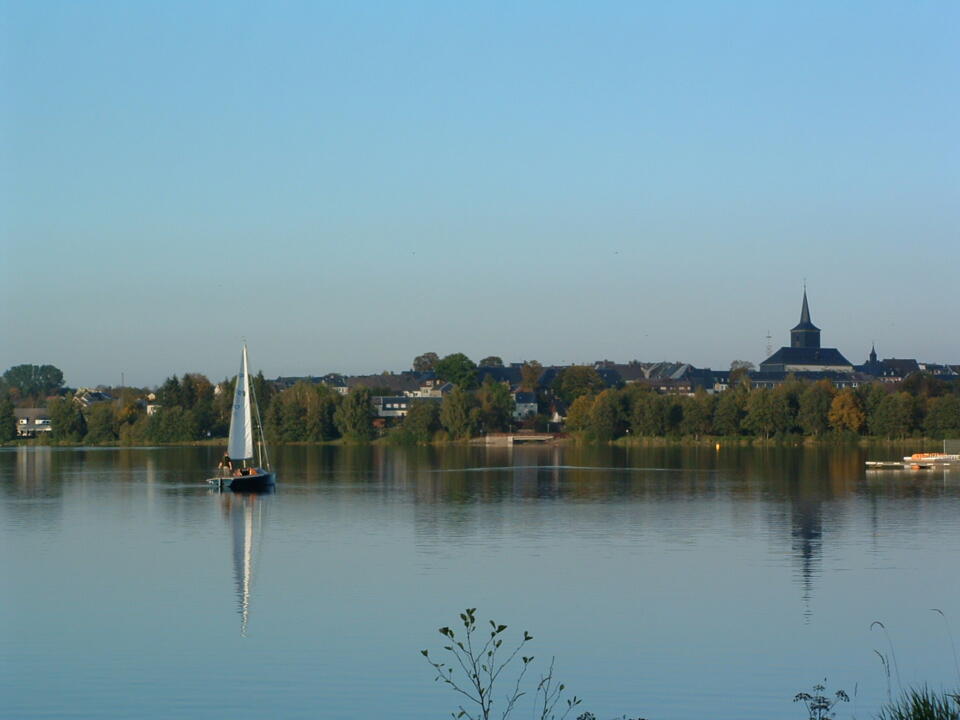
Weißenstadt Lake
Weißenstadt lake (50 ha) is the biggest lake in Fichtelgebirge. Because of its central location in the region, it is a popular destiny for people of all ages. W…

The Story of the Bergkristall
Weißenstadt is also known as the town on “crystal ground”: several veins of rock crystal run through the ground beneath it.
Show transcript
Around 300 million years ago, the collision of the continental plates of Gondwana and Laurussia during the Variscan orogeny also began to form what would later become the Fichtel Mountains. Magma forced its way up from deep within the Earth, under high pressure and at high temperature, into the folding mountain range, where it eventually solidified into granite. As it cooled, and as a result of further tectonic changes, cracks and fissures formed in the granite and filled with mineral solutions. As pressure and temperature fell, these crystallised and formed quartz veins, which became enriched with pyrite, cassiterite or other minerals. Beneath Weißenstadt – as Gümbel describes in his geognostic description of the Fichtel Mountains – there runs a quartz vein that is distinguished by the frequent occurrence of beautiful, water-clear quartz crystals, such as are also found on the Strahlenberg, at the Egkerte and near Bernstein.

Ehrenhain Memorial Grove and War Memorial
The Ehrenhain is a park on Kirchenlamitzer Straße, flanked by a row of historic barns.
Show transcript
The Ehrenhain is a park on Kirchenlamitzer Straße, flanked by a row of historic barns. At the centre of the park stands the war memorial. It was erected in honour of the soldiers who fell in both World Wars. It is made of local granite and depicts the monumental figure of a warrior – a Roland figure. The Roland figure also serves as a symbol of freedom. The Weißenstadt sculptor Christian Neuper created the war memorial, which was dedicated on 2 October 1928. The plinth of the Roland figure shows the years in which each of the wars ended, 1918 and 1945, with the Weißenstadt coat of arms in the middle. The memorial is 4.20 m high and weighs around 150 hundredweight. After 1945 the site was enlarged and the park around the memorial was laid out as the Ehrenhain, a memorial grove. To this day, a solemn wreath-laying ceremony is held every year on the National Day of Mourning (Volkstrauertag) in remembrance of those who fell in the two World Wars. The Ehrenhain with its war memorial is listed as a historic monument by the Bavarian State Office for Monument Protection.

Catholic Church of St Mary Immaculate
The first Catholic faithful came to Weißenstadt around the turn of the 20th century. The Catholic church was built in 1936.
Show transcript
The first Catholic faithful came to Weißenstadt around the turn of the 20th century. The Catholic church was built in 1936. From the middle of the 19th century, the gradual extension of the railway line from Regensburg to Hof brought great economic growth to the Fichtel Mountains. The weaving mills, the glassworks, the quarrying and working of granite and the porcelain industry led in many places to an unprecedented economic boom in the region. Rapid industrialisation soon caused a shortage of labour, which was offset by people moving in from the Upper Palatinate and other regions. The newly arrived workforce was largely Catholic, which made it necessary to found congregations and build prayer rooms. The parish of Wunsiedel, too, had to respond to the changed situation in order to meet the pastoral needs in Marktleuthen, Kirchenlamitz, Röslau and Weißenstadt. At first a prayer room was set up in Marktleuthen. But for the Catholics of Weißenstadt, the walk of more than 13 km was long and arduous. At the request of the parish priest at the time, the Italian-born master builder Emil Peruzzi set up a prayer room in 1912 in his newly built house on Egger Straße / Badstraße. Back then, the priest from Marktleuthen held a Catholic service here every two to three weeks. When the Weißenstadt church of St Mary Immaculate was completed in 1936, the prayer room was closed and completely converted by the Peruzzi family for private use. When the prayer room in Weißenstadt became too small for the number of Catholics, the then parish priest of Weißenstadt, Georg Eckfuß, decided to build a church. The foundation stone was laid on 26 October 1935, and as early as 30 August 1936 Archbishop Dr Michael Buchberger of Regensburg consecrated the Marienkirche (St Mary’s Church). It was also he who placed the church under the patronage of Mary Immaculate (Mary conceived without original sin). Pastoral care continued to be provided by the priests from Marktleuthen. In 1951 Weißenstadt became an expositure, in 1977 a parish curacy, and on 8 December 2001, the day of the Solemnity of the Immaculate Conception, it was raised to the status of a parish. Today the parish of Weißenstadt is once again looked after from the parish of Marktleuthen. The Marienkirche was designed in the Neo-Romanesque style by the Munich architect Georg Berlinger, who conceived the building as a choir-tower church. The presbytery is built into the ground floor of the tower. Adjoining it, the nave was added to house the pews. This style is modelled on the way village churches were built in the early Middle Ages. The entire Catholic church was built of granite, in keeping with the natural stone of the Fichtel Mountains. The church is over 20 metres long and 9 metres wide. The massive-looking tower reaches a height of 22 metres. Built onto the side of the church is the sexton’s house, which contains the sacristy and the living quarters. After the church was built, three bells hung in the tower. During the Second World War the two larger ones had to be handed over to be melted down; the smallest, known as the St Joseph bell, survived. On the Feast of Christ the King in 1964, the two lost bells were replaced. They bear the names Mary bell and Boniface bell. The new parish house was inaugurated in 1964. In 1970 the Marienkirche at last received its long-awaited organ.
The Digital Town Tour is funded through the regional budget of ILE Gesundes Fichtelgebirge e.V.
